

⏩ Is Wearing Henna Only For Married Women? – Shaikh Abdul-Muhsin al-‘Abbad
Question : Is using henna specifically for married women? Is this correct?
Answer : “This is not correct as is well known. No doubt women who are married have a need to beautify themselves for their husbands and there is no harm in training the young girls to wear henna. It is not a condition that beautification is only for husbands. Rather a woman can beautify using henna and use henna even if she is not married. As long as it does not lead to harm or fitnah. This is because this (henna) is from the affairs of the women”.
[Sharh Sunan Abi Dawood no. 468]
Translated by
Faisal Ibn Abdul Qaadir Ibn Hassan
Abu Sulaymaan
http://torontodawah.com/?p=10834
The ruling on the one who doubts the kufr of someone who says the Qur’an is created | Sh. Muhammad Hizaam hafidhahullaah
بسم اللــــه الرحمـــــــــن الرحيم
📩 الســـــــؤال
The question:-
يقول السائل: من قال إن القرآن مخلوقٌ فهو كافر وسمعت بعض العلماء يقول من شك في كفر القائل بخلق القرآن فهو كافر , هل هذا صحيح ؟
The questioner says: The one who says the Qur’an is created is a kaafir and I heard some of the ‘ulama say whoever doubts the disbelief of the one who says the Qur’an is created is also a kaafir, is this correct?
📝 الإجــــــــــــابة
The answer:-
نعم – القرآن كلام الله صفة من صفاته من قال إنه مخلوق فهو كافر ومن شك في كفره فهو كافر أيضاً – كفره صريح متعين لاشك فيه.
Yes – The Qur’an is the speech of Allah, an attribute from his attributes. Whoever says the Qur’an is created is a kaafir and whoever doubts in his disbelief is a kaafir as well. His disbelief is clearly expressed, no doubt in it.
_______________________
للاشتراك في قناة :-
فتاوى الشيخ الفقيه محمد بن حزام
على التلجرام :- @ibnhezam
A Brief Breakdown of the Seventy-Three Sects in Islam Compiled by: Faisal Ibn Abdul Qaadir Ibn Hassan Abu Sulaymaan
Below is a link to a short article the brother Faisal Abu Sulayman compiled about the 73 sects in Islam, their names and origins. May Allah bring benefit to it:
Beware of following a position or opinion in Islaam for the mere sake of following your desire
⚠ *Beware of following a position or opinion in Islaam for the mere sake of following your desire*⚠
*Following your desire Vs Following the Truth*
*Bismillah*
When this religion was one of ease, far removed from burden and hardship, Allaah made the Halal and the Haraam distinguishably clear. Likewise as the Messenger salallahu aleyhi wa Sallam informed, there is between the Halal and Haraam, things which are obscure and unknown to most of mankind, a relatively grey area if you like.
I wanted to address here, something which is manifestly troublesome to some Muslims. For the sake of brevity, we’ll refer to it here as “Fatwa Shopping” (though in reality it encompasses more than this).
This affair of “Fatwa Shopping” is a main point of difference between Ahlus Sunnah wal jamaa’a and the people of innovation, who are referred to as the people of desires incidently. It is also important to note, that this is not an entirely new concept, quite the opposite, the innovators of old such as the ‘Mu’tazilah and Ashaa’ira used to search far and wide for arabic verses of poetry to aid their corrupt creed of denying Allaah’s Beautiful Names and Lofty Attributes.
Below, I give examples for adopting a view (which is often aided by the views or statements of scholars), merely for the sake of justifying actions desired by one’s soul. The points in themselves are not necessarily right or incorrect, i.e. that is not what is intended here.
*Examples:*
*1) The two rakahs upon entering the masjid*
For instance, one may be too lazy to pray two rakahs upon entering the masjid. This laziness then leads him to choose the more convenient fiqh position that the 2 rakahs are recommended and not obligatory.
*2) Shortening the beard*
One may not want to grow his beard for one reason or another. So he then adopts a fiqh position which compliments his desire, for instance Sheikh Albani’s view that a beard in excess of a fist can be trimmed.
*3) Consuming the meat of the people of the Book*
One may enjoy eating the food of McDonald’s and Pizza Hut and their likes. So then, he uptakes a position which enables him to eat there, fostering the view that they are from Ahlul Kitaab (the people of the book) and thus their meat is Halal and permissible to consume.
*4) Appearing in videos*
One may believe that he can reach greater audiences and his dawah will find more acceptance if he were to use video as a means of dawah. So he subsequently adopts the view that videos are not a form of picture taking, but is similar to a mirror reflection.
✒ So to conclude, the way of Ahlus Sunnah is that they research an affair and then act in accordance to their research outcomes. Whereas the people of desires, adopt a practice or belief first, only to go and search for proofs to support their desire-driven view later.
⚠ *Beware of this Oh Muslim!*
Allaah says to his Prophet Dawud aleyhi Salaam in the Quran:
يَا دَاوُودُ إِنَّا جَعَلْنَاكَ خَلِيفَةً فِي الْأَرْضِ فَاحْكُم بَيْنَ النَّاسِ بِالْحَقِّ وَلَا تَتَّبِعِ الْهَوَىٰ فَيُضِلَّكَ عَن سَبِيلِ اللَّهِ
*O Dawud! Verily We have placed you as a successor on earth, so judge between men in truth (and justice) and follow not your desire for it WILL MISLEAD you from the Path of Allah.*
_[Saad: Verse 26]_
_And Allaah’s aid is sought. Wa laa howla wa laa quwata ila Billaah._
*Written by*
_Abu Mu’aawiyah Abdullah Hassan_
_غفر الله له ولوالديه_
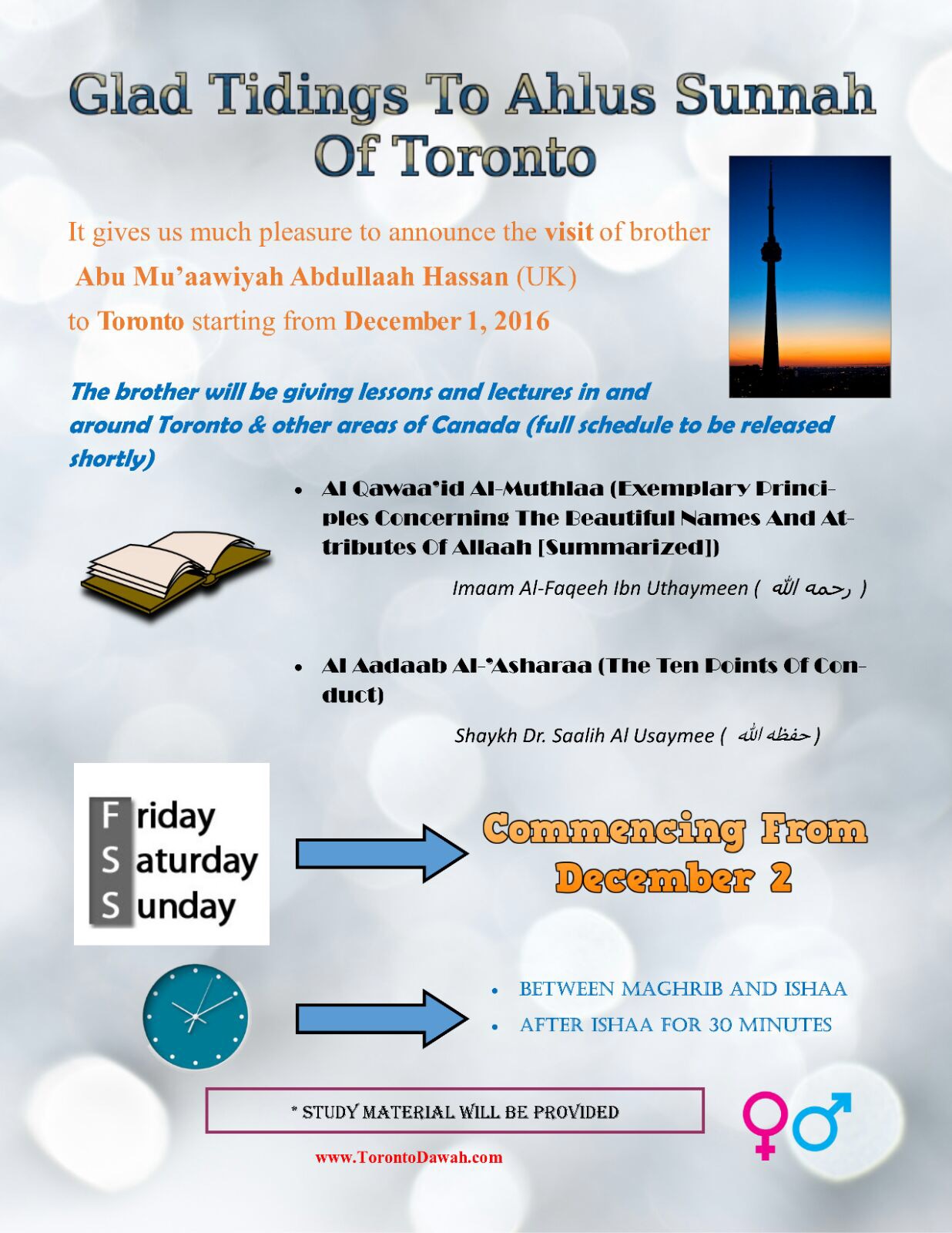
Glad tidings to ahlus sunnah of Toronto
The How to Deal with Slackness in Seeking Knowledge – The Permanent Committee
The How to Deal with Slackness in Seeking Knowledge – The Permanent Committee
Question: How do we confront slackness in seeking knowledge?
Answer: “Seeking knowledge is a worship through which a person draws near to Allah. Whoever treads a path to seek knowledge, Allah will make his path to paradise easy. Shaytan sits in the pathway of the son of Adam, in the path of good in order to discourage him and make him slack.
It is upon the student of knowledge to adorn himself with the etiquette which will help him seek knowledge and continue upon the path of seeking it. From that:
1. Sincerity to Allah, the Exalted. He should intend by seeking knowledge the Face of Allah and the hereafter. He should not seek knowledge to obtain the worldly life nor to attain status. Whoever is sincere to Allah in that, then he will be motivated to exert effort in seeking knowledge and bearing the difficulty and troubles. It will aid him in treading his path and continuing upon it
2. Seriousness in seeking knowledge and patience upon obtaining it and bearing the difficulty in regards to it. For knowledge is not obtained by the comfort of the body, just as it is not obtained by wishful thinking nor by saying: “Would have I only did…” or “I will” or “If only I…”. However, it is obtained through seriousness and patience upon its difficulties
3. Gradual obtainment of that by concerning oneself with the foundations of knowledge before its secondary issues and the smaller types knowledge before the bigger types of knowledge. Whoever tries to attain knowledge in one go, it will go in one go. Whoever learns it gradually and establishes the building, brick by brick, then he will reach its completion by the permission of Allah
4. Eagerness in overcoming the obstacles in front of him whether it is academic obstacles or other than it. Overcoming the academic obstacles is by asking questions, researching, and reviewing knowledge with classmates and the Mashaaikh, and debating issues without argumentation
5. Specializing in one science from the academic sciences along with obtaining something of the other sciences which are connected to the science. Ibn Qutaybah said: “Whoever wants to obtain knowledge, then let him seek one science [at a time]”
6. Beware of coming forth [for teaching] before being qualified [to do so] for that is a sign of failure and cause of boredom. It is upon the student of knowledge to be aware of the means that lead to slackness and boredom. From them:
1. Weakness in ambition and loss of resolve
2. Following the desires of the soul and the lure of Shaytan towards comfort and lack of fatigue in regards to seeking of knowledge. As well as demoralization [by thinking] that no matter how serious one is, he will not gain the status of the Scholars and students of Knowledge
3. Complacency and [finding] repose in distractions/amusements which turn one away from seeking knowledge, waste time, and do not benefit
4. Accompanying idle people who do not have a concern for knowledge nor know the value of time. Their ambition is only “he said/she said” and wasting time. The Prophet (ﷺ) prohibited bad friends and encouraged us to accompany those who are good. As is in the Hadith of Abu Musa (may Allah be pleased with him) that the Prophet(ﷺ) said:
إنما مثل الجليس الصالح والجليس السوء كحامل المسك ونافخ الكير، فحامل المسك إما أن يحذيك وإما أن تبتاع منه، وإما أن تجد منه ريحًا طيبة، ونافخ الكير إما أن يحرق ثيابك، وإما أن تجد منه ريحًا خبيثة
The example of a good pious companion and an evil one is that of a person carrying musk and another blowing a pair of bellows. The one who is carrying musk will either give you some perfume as a present, or you will buy some from him, or you will get a good smell from him, but the one who is blowing a pair of bellows will either burn your clothes or you will get a bad smell from him [Agreed upon]
Countering slackness in seeking knowledge is by having the etiquette of seeking knowledge and avoiding the means of slackness and acting upon what will benefit you in bypassing it and avoiding it.
We mentioned some etiquette of means of slackness in what has preceded. A student of knowledge should be aware of the high status of knowledge and the great reward with Allah, the Exalted. He should know that preoccupying oneself with it is best thing which effort can be exerted towards and it is the Prophetic inheritance. Whoever takes it has taken an abundant portion. The Prophet (ﷺ):
وإن العلماء ورثة الأنبياء وإن الأنبياء لم يورثوا دينارًا ولا درهمًا، وإنما ورثوا العلم فمن أخذه أخذ بحظ وافر
Scholars are the heirs of the Prophets, and the Prophets leave neither dinar nor dirham, leaving only knowledge, and he who takes it takes an abundant portion [Saheeh Sunan Dawood no. 3641]
Allah said:
وَمَا كَانَ الْمُؤْمِنُونَ لِيَنْفِرُوا كَافَّةً فَلَوْلا نَفَرَ مِنْ كُلِّ فِرْقَةٍ مِنْهُمْ طَائِفَةٌ لِيَتَفَقَّهُوا فِي الدِّينِ وَلِيُنْذِرُوا قَوْمَهُمْ إِذَا رَجَعُوا إِلَيْهِمْ لَعَلَّهُمْ يَحْذَرُونَ
And it is not (proper) for the believers to go out to fight (Jihad) all together. Of every troop of them, a party only should go forth, that they (who are left behind) may get instructions in (Islamic) religion, and that they may warn their people when they return to them, so that they may beware (of evil) [9:122]
May Allah grant us success. May peace and blessings be upon our Prophet Muhammad, his family, and Companions.
[http://www.alifta.net/fatawa/fatawaDetails.aspx?BookID=3&View=Page&+PageNo=7&PageID=15138&languagename=]
Translated by
Faisal Ibn Abdul Qaadir Ibn Hassan
Abu Sulaymaan
An advise to those who like to take pictures of their belongings and post it
An advise to those who like to take pictures of their belongings and post it:
Imam Ibn Hazm Al Andalusi May Allah Have mercy upon him said:
“How many have we seen from those who boast with that which he owns from belongings, and thus it was a reason for its destruction, either due to the evil eye of an envious one or the plotting of an enemy. Thus beware of this (boasting with that which one owns) for it is purely a harm and no benefit in it”
From the book Al Akhlaq Was Siyar
Majid Jawed Al Afghani
Excerpt from the introduction of the class ‘Nullifiers of Islam’ for Muslim Children: ‘Who is a Scholar in Islam, and What is a Scholar in Islam’ by Abul Baraa Muhammad Amreeki at Rockaway Islamic Center. – Islam’s Finest
Benefits on fasting ashoora
Shaikh Muhammad Ibn Hizaam hafidhuhallah wrote:
“Fasting ‘Ashoora
It comes in the Saheeh Muslim from Abu Qatadah (may Allah be pleased with him) that the Prophet (ﷺ) was asked about fasting on the day of ‘Ashoora. He said: “It expiates the sins of the past year”
An-Nawawi (mercy be upon him) said in Sharh Saheeh Muslim (8/4): “The Scholars agreed that fasting ‘Ashoora is Sunnah”.
They differed regarding day of ‘Ashoora. The majority of the Scholars of the Salaf and those who came after them were of the opinion that ‘Ashoora is the tenth of Muharram.
It was said it is the ninth day. They said: it is the opinion of Ibn Abbas (may Allah be pleased with him) and they used as evidence what is in Saheeh Muslim:
Hakam b. al-‘Araj reported:
I went to Ibn ‘Abbas (Allah be Pleased with both of them) and he was reclining using his mantle as a pillow near the fountain of Zamzam. I said to him: Tell me about fasting on Ashura. He said: When you see the new moon of Muharram then count the (days) and observe fast on the 9th. I said to him: Is it how the Messenger of Allah (ﷺ) observed the fast? He said: Yes.
What is apparent is that Ibn Abbas (may Allah be pleased with him) intended by fasting the ninth to oppose the Jews, not that ‘Ashoora is the ninth due to the evidence of what came in Saheeh Muslim:
– يَقُولُ حِينَ صَامَ رَسُولُ اللَّهِ صلى الله عليه وسلم يَوْمَ عَاشُورَاءَ وَأَمَرَ بِصِيَامِهِ قَالُوا يَا رَسُولَ اللَّهِ إِنَّهُ يَوْمٌ تُعَظِّمُهُ الْيَهُودُ وَالنَّصَارَى . فَقَالَ رَسُولُ اللَّهِ صلى الله عليه وسلم “ فَإِذَا كَانَ الْعَامُ الْمُقْبِلُ – إِنْ شَاءَ اللَّهُ – صُمْنَا الْيَوْمَ التَّاسِعَ ” . قَالَ فَلَمْ يَأْتِ الْعَامُ الْمُقْبِلُ حَتَّى تُوُفِّيَ رَسُولُ اللَّهِ صلى الله عليه وسلم.
That when the Messenger of Allah (ﷺ) fasted on the day of ‘Ashoora and commanded that it should he observed as a fast, they (his Companions) said to him:Messenger of Allah, it is a day which the Jews and Christians hold in high esteem. Thereupon the Messenger of Allah (ﷺ) said: When the next year comes, God willing, we would observe fast on the ninth. But the Messenger of Allah (ﷺ) died before the advent of the next year.
And what supports that is what is established from Sa’eed ibn Mansoor with a Saheeh chain as is in the book al-Iqtidaa as-Siraat al-Mustaqeem from Ibn Abbas (may Allah be pleased with him): “Fast the ninth and tenth, oppose the Jews”
[See: Sharh Saheeh Muslim (8/11-12), Fath (no. 2008), and Tafseer al-Qurtubi (1/391)]
Combining Between the Ninth and Tenth Day
It is benefited from the Hadith from Ibn Abbas (may Allah be pleased with him) in the previous issue that it is recommended to fast the ninth with the tenth in opposition to the Jews. The majority of the Scholars recommended it. From them is Shafi’ee and Ahmad (may Allah have mercy upon them)
[See: Sharh Muslim (8/12-23) and Tawdeeh al-Ahkaam (3/201)]
Wisdom Behind the Command to Fast ‘Ashoora
In the Saheeh on the authority of Ibn Abbas (may Allah be pleased with them) that:
أَنَّ رَسُولَ اللَّهِ صلى الله عليه وسلم قَدِمَ الْمَدِينَةَ فَوَجَدَ الْيَهُودَ صِيَامًا يَوْمَ عَاشُورَاءَ فَقَالَ لَهُمْ رَسُولُ اللَّهِ صلى الله عليه وسلم ” مَا هَذَا الْيَوْمُ الَّذِي تَصُومُونَهُ ” . فَقَالُوا هَذَا يَوْمٌ عَظِيمٌ أَنْجَى اللَّهُ فِيهِ مُوسَى وَقَوْمَهُ وَغَرَّقَ فِرْعَوْنَ وَقَوْمَهُ فَصَامَهُ مُوسَى شُكْرًا فَنَحْنُ نَصُومُهُ . فَقَالَ رَسُولُ اللَّهِ صلى لله عليه وسلم ” فَنَحْنُ أَحَقُّ وَأَوْلَى بِمُوسَى مِنْكُمْ ” . فَصَامَهُ رَسُولُ اللَّهِ صلى الله عليه وسلم وَأَمَرَ بِصِيَامِهِ
That the Messenger of Allah (ﷺ) arrived in Medina and found the Jews observing fast on the day of ”Ashoora. The Messenger of Allah (ﷺ) said to them:
What is the (significance) of this day that you observe fast on it? They said: It is the day of great (significance) when Allah delivered Moses and his people, and drowned the Pharaoh and his people, and Moses observed fast out of gratitude and we also observe it. Upon this the Messenger of Allah (ﷺ) said: We have more right, and we have a closer connection with Moses than you have; so Allah’s Messenger (ﷺ) observed fast (on the day of ‘Ashoora), and gave orders that it should be observed.
[See: Sharh Muslim (8/9)]
Note:
It was mentioned in the previous Hadith: “It expiates the sins of the past”. What is apparent is that fasting the day of ‘Ashoora expiates the minor and major sins. However, the majority of Scholars are of the opinion that it does not expiate the major sins. If one fasts the day of Arafah and the day of ‘Ashoora, then they are not better than fasting Ramadan nor are they better than the five obligatory prayers.
The Prophet (ﷺ) said:
الصَّلَوَاتُ الْخَمْسُ وَالْجُمُعَةُ إِلَى الْجُمُعَةِ وَرَمَضَانُ إِلَى رَمَضَانَ مُكَفِّرَاتٌ مَا بَيْنَهُنَّ إِذَا اجْتَنَبَ الْكَبَائِرَ
The five (daily) prayers and from one Friday prayer to the (next) Friday prayer, and from Ramadhan to Ramadhan are expiations for the (sins) committed in between (their intervals) provided one shuns the major sins [Reported by Muslim from the authority Abu Hurariah (may Allah be pleased with him)]
This is the statement of the majority of the Scholars and it is the more correct opinion.
[See: Sharh Muslim (6/383) and Tawdeeh al-Ahkam (3/201)]”
[Ithaaf al-Anaam (pg. 160-163)]
So this is a reminder for the brothers to fast the ninth and tenth of Muharram which is:
Monday Oct 10, 16 (Ninth of Muharram)
Tuesday Oct 11, 16 (Tenth of Muharram)
And Allah Knows Best
Faisal Ibn Abdul Qaadir Ibn Hassan
Abu Sulaymaan
 aljamaykee.com